
The Business Behind Quick Commerce: How Dark Stores Work How Dark Stores Work
Zepto, Blinkit, and Swiggy Instamart promise groceries in ten minutes. The infrastructure that makes this possible — and the economics that make it precarious — is worth understanding.
The Promise Is Ten Minutes
Somewhere in the gap between "I need milk" and "the milk is at my door," an entirely new category of business was invented. Quick commerce — q-commerce — is not faster e-commerce. It is a fundamentally different retail model built around one constraint: delivery in under thirty minutes, with the best players targeting ten.
Understanding how this works requires understanding the dark store: the invisible piece of infrastructure that makes the promise physically possible.
What Is Quick Commerce?
Quick commerce is the delivery of groceries, household essentials, and convenience items within 10 to 30 minutes of an order being placed. It is distinct from traditional e-grocery (BigBasket, Amazon Fresh) which operates on next-day or same-day delivery windows of several hours.
The scale of the Indian quick commerce market is not small. Zepto reported revenue of roughly ₹11,110 crore in FY25 — up approximately 150% year-on-year. Blinkit, now owned by Zomato, processes millions of orders monthly. Swiggy Instamart operates across dozens of Indian cities. The combined GMV across all players runs into tens of thousands of crore rupees annually.
The key players in India are Zepto (founded 2021, Bangalore-based), Blinkit (formerly Grofers, acquired by Zomato in 2022), and Swiggy Instamart (Swiggy's q-commerce vertical). Each competes on delivery speed, product range, and pricing — but all three rely on the same underlying infrastructure model.
The Dark Store: What It Is and What It Is Not
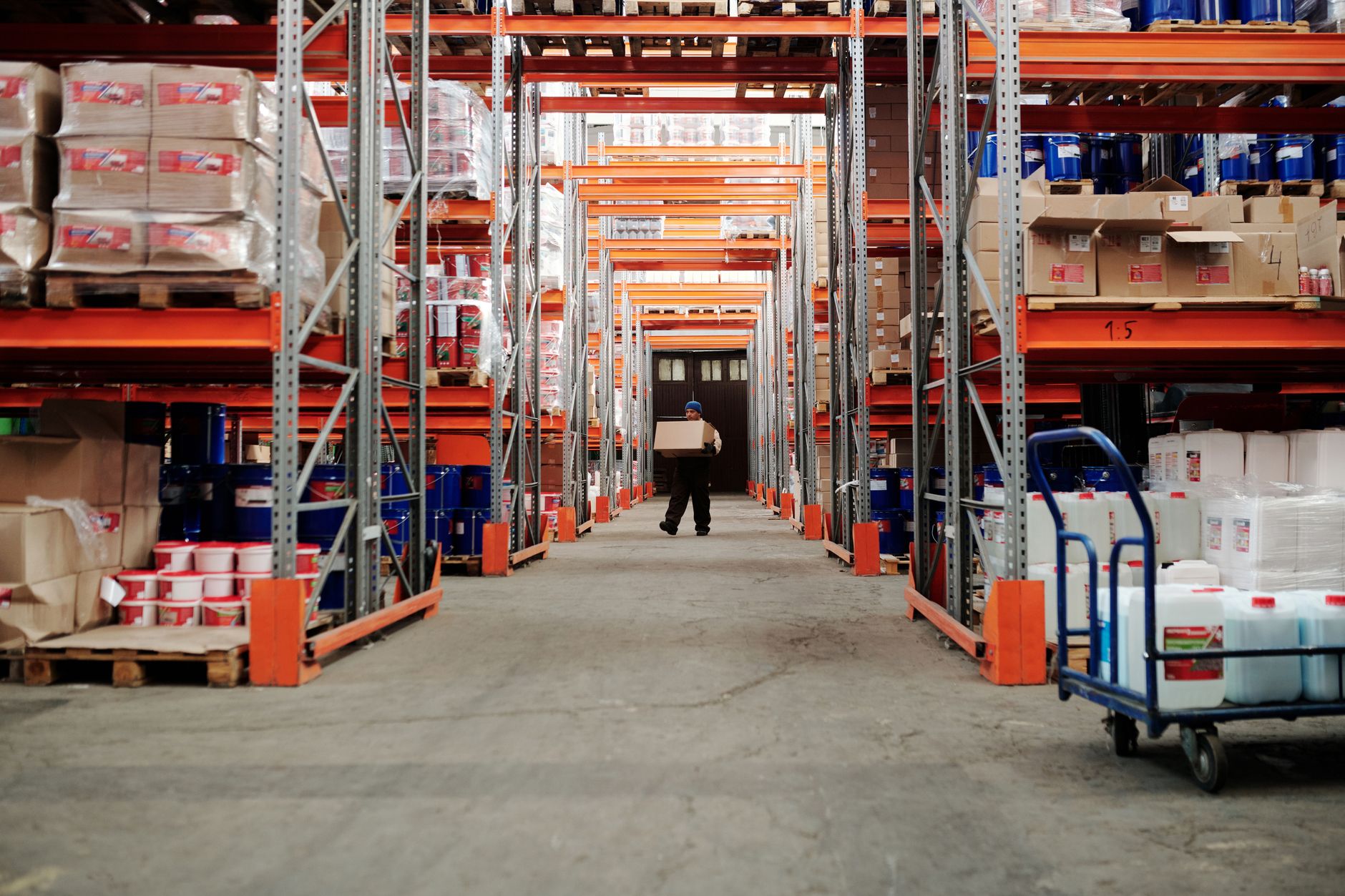
A dark store is a small warehouse — typically 1,500 to 3,000 square feet — located in a dense urban area, stocked with a curated range of groceries and essentials, and operated exclusively for order fulfilment. It has no walk-in customers. No retail floor. No signage designed to attract foot traffic. It is dark to consumers by design.
What dark stores are:
- Micro-fulfilment centres positioned within 2 to 3 kilometres of a dense residential cluster
- Stocked with a tightly curated SKU range (typically 2,000 to 5,000 items versus 20,000+ at a supermarket)
- Staffed by pickers who pull orders and delivery partners who execute the last mile
- Optimised for picking speed, not browsing
What dark stores are not:
- Traditional warehouses (too large, too far from customers, optimised for bulk movement)
- Ghost kitchens (which prepare food; dark stores stock pre-packaged goods)
- Retail stores with restricted entry
The 2 to 3 kilometre radius is not arbitrary. At that distance, a two-wheeler rider can complete a delivery and return to the dark store within roughly 15 minutes, allowing for order prep time. Extend the radius to 5 kilometres and the delivery window blows past 30 minutes. Compress it below 1 kilometre and you need too many dark stores to cover a city.
How an Order Actually Works
When a customer places an order on Zepto or Blinkit, the app routes it to the nearest available dark store that has all the requested items in stock. The sequence from there:
- Order assignment — the picking system assigns the order to an available picker inside the dark store, with a target pick time of under 2 minutes for a standard basket.
- Pick and pack — the picker moves through the store pulling items. Dark stores are laid out for speed, not browsing: high-velocity items (eggs, bread, water, soft drinks) are near the packing station, long-tail items are further back.
- Handoff — the packed order moves to a delivery partner waiting at or near the dark store. The best-run stores aim for a handoff within 5 minutes of the order being placed.
- Last-mile delivery — the delivery partner, almost always on a two-wheeler, executes the final 1 to 3 kilometre leg. At this distance, 10 to 15 minutes is achievable in normal traffic.
The entire chain — from order to doorbell — takes 10 to 20 minutes in a well-optimised dark store. The weakest links are picker speed (which improves with store layout and training) and delivery partner availability (which fluctuates with demand and time of day).
The Unit Economics: Why This Business Is Hard
The dark store model works logistically. The economics are a different story.
A typical quick commerce order in India has an average order value (AOV) of ₹400 to ₹600. The costs against that order include:
- Cost of goods — typically 65 to 75% of revenue, leaving a gross margin of 25 to 35% before operating costs.
- Delivery cost — paying a delivery partner ₹40 to ₹80 per order (varies by city, time of day, and distance). Many platforms subsidise or waive delivery fees below a certain order value, absorbing this cost themselves.
- Dark store operating costs — rent in dense urban areas is expensive. A 2,000 square foot store in a Mumbai or Bengaluru residential neighbourhood costs ₹80,000 to ₹2,00,000 per month. Add utilities, store staff, inventory shrinkage (perishables spoil), and technology.
- Platform overhead — customer acquisition, marketing, app development, and corporate overhead.
At low order volumes, most dark stores lose money on every order. The path to unit economics working requires high order density — many orders per hour from the same dark store's coverage area — which keeps delivery partners busy and amortises fixed costs across more revenue.
This is why q-commerce is an inherently urban, density-dependent business. A dark store serving a dense Mumbai neighbourhood with 500 orders a day has very different economics from one serving a low-density suburb with 80 orders a day. The former can approach contribution-margin positivity. The latter almost certainly cannot.
The Capital Question
Scaling a dark store network requires significant upfront investment. Each new dark store requires a lease deposit, fit-out, initial inventory, and staff hiring before it generates a single rupee of revenue. A network of 100 dark stores — a mid-sized city presence — might require ₹50 to ₹100 crore in working capital just to stock and operate.
This is why q-commerce players have raised enormous amounts of venture capital. Zepto has raised over $1 billion across multiple rounds. Blinkit raised several hundred million dollars before its Zomato acquisition. The fundraising is not growth capital in the traditional sense — it is the working capital required to build a physical network that takes years to reach aggregate profitability.
The burn rate during expansion is high: new dark stores, new cities, delivery partner incentives, discounts to acquire customers in new markets. The model demands patience from investors and a belief that once density reaches a critical threshold, the economics flip.
Competitive Dynamics
The Indian q-commerce market has narrowed significantly from its peak of a dozen players in 2021–22. Dunzo, once a leading q-commerce player, struggled to raise capital and pulled back from most markets. BigBasket's BBNow has had a limited presence. The market has effectively consolidated around three players: Zepto, Blinkit, and Swiggy Instamart.
This consolidation was predictable. Quick commerce is a winner-takes-most business in each city because:
- Higher order density per dark store is the key to unit economics
- The player with the most orders per store can afford the best inventory, the most delivery partners, and the most aggressive pricing
- Once a consumer adopts one app and builds a habit, switching costs are real (saved addresses, payment methods, familiarity)
The survivors have raised enough capital to outlast the competition and are now focused on reaching EBITDA-positive dark stores, expanding into tier-2 cities (Jaipur, Lucknow, Coimbatore), and broadening their SKU range into higher-margin categories like electronics accessories, cosmetics, and over-the-counter medicines.
The Challenges That Don't Go Away
Even for the surviving players, several structural challenges persist.
Perishability — fresh produce, dairy, and bakery items have shelf lives of days. Forecasting demand well enough to stock without spoilage is a continuous inventory management problem. Overstock means write-offs. Understock means poor availability and lost orders.
Labour — delivery partners are gig workers, not employees. Their availability, reliability, and satisfaction directly affect delivery speed. Zepto and others have faced delivery partner strikes over pay disputes. The relationship between q-commerce platforms and their delivery workers is under regulatory scrutiny.
Real estate — finding 2,000 square feet in the right residential neighbourhood at an acceptable rent is harder than it sounds. Residential neighbourhoods often have restrictions on commercial activity. The best locations get competitive. Lease terms are rarely long enough to provide stability.
City regulations — operating a commercial fulfilment centre in a residential area requires the right permits. As dark stores have proliferated, some municipal bodies have tightened requirements, forcing store relocations.
What the Future Looks Like
The q-commerce market in India is entering a consolidation and maturation phase after the expansion frenzy of 2021–24. A few trends are clear:
Profitability pressure is real. Investors who funded the land-grab phase are now demanding a path to positive unit economics. Platforms are raising delivery fees, increasing minimum order values, and cutting customer discounts. This is rational but will slow growth.
Tier-2 and tier-3 cities are the next frontier. The metro markets (Mumbai, Bengaluru, Delhi, Hyderabad, Pune) are largely served. The next wave of dark store expansion is heading to cities with smaller but still-dense urban populations. The economics in these cities are harder — lower AOV, lower order density — but the competition is also lower.
AI-driven demand forecasting is becoming a genuine differentiator. Dark stores that can predict what their neighbourhood will order on a rainy Tuesday evening — and stock accordingly — have lower shrinkage, higher availability, and better economics. The platforms investing in this will have a durable operational advantage.
Category expansion is key to improving margins. Groceries are thin-margin. Electronics accessories, cosmetics, and pharmaceuticals carry margins of 30 to 50%. The dark stores that evolve into neighbourhood convenience hubs — not just grocery stores with two-wheeler delivery — have a more viable long-run model. If you are thinking about whether this model could translate into a business idea, validating the concept before investing is especially important in capital-intensive categories like fulfilment.
A New Retail Paradigm
Quick commerce represents a genuine shift in how urban India thinks about grocery shopping. The habit formation is real: once you have ordered milk at 11pm and had it arrive in twelve minutes, the weekly supermarket trip starts to feel archaic.
Whether the current players will all survive long enough to build truly profitable businesses is a separate question. What is not in doubt is that the dark store model — small, dense, urban, invisible, fast — has permanently changed consumer expectations around convenience retail. The infrastructure is being built now. The economics will catch up eventually, or the category will consolidate further until they do.
Continue reading


The Entrepreneur Story
Is your story worth telling?
We feature founders who are building something real. Apply and we'll be in touch.
Apply to be featured →Stay sharp.
Ideas that move.
Founder stories, emerging ventures, and essays on what's next — straight to your inbox.
Unsubscribe any time.